Many successful pet brands do not start with a big team, a large budget or a complete product collection.
Sometimes, they start with one small pet store.
As a pet product supplier, we have had the opportunity to work with many businesses at different stages of growth. Some are just beginning to explore custom products. Others already have an established customer base but are still selling products from multiple third-party brands.
One of our customers followed a journey that many independent pet store owners may recognize.
Their story began as a small pet store selling carefully selected pet accessories from different brands. Over time, they faced several challenges that eventually led them to make an important decision: instead of only selling other brands, they decided to start building one of their own.
Today, their own branded products have become an important part of their business, and their brand has grown beyond their original store.
This is their story.
The Beginning: A Store Selling Other Brands
When we first started working together, our customer was running a small pet store.
Like many independent pet stores, they carefully selected products from different established pet brands and sold them to their customers. Their product range included harnesses, collars, leashes and other pet accessories.
The business was doing well, but over time, they began to face several challenges.
The first challenge was pricing.
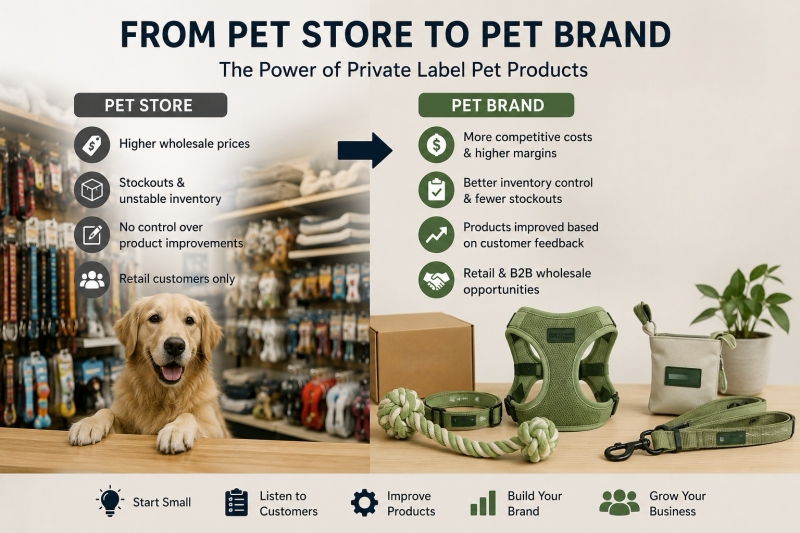
Because they were purchasing finished products from other brands, their wholesale prices were relatively high. This limited their profit margins and made it more difficult to maintain competitive pricing while still achieving healthy profitability.
The second challenge was inventory.
The customer depended on other brands to keep their best-selling products in stock. Occasionally, a popular product would sell out, but replenishment was not always available immediately. Some products remained out of stock for a period of time, which meant the pet store could not meet customer demand and potentially lost sales.
Another challenge was product development.
After selling certain products for a while, the customer sometimes received feedback from pet owners and noticed areas where the product design could be improved.
Perhaps a feature was not practical enough. Perhaps a detail could be more comfortable for pets. Or perhaps customers wanted a different function, material or design.
However, because the products belonged to other brands, there was very little the customer could do.
They could identify the problem, but they could not easily change the product.
Over time, the owner realized that selling other brands gave them limited control over three important parts of their business: pricing, inventory and product development.
This eventually led to an important question:
“Why not create our own products?”
The First Step: Starting Their Own Brand
Like many small pet businesses, the customer did not want to make a large investment in a completely new collection immediately.
There were understandable concerns about minimum order quantities, inventory risks and whether customers would actually buy products under a new brand.
So, we started small.
Instead of developing everything from scratch, the customer began with several carefully selected product styles and focused on building a recognizable brand identity around them.
They chose colors, patterns and branding elements that better matched the style of their business. We supported them with product development, design mock-ups, sampling and production.
The first order was relatively small.
It was not a huge launch, and there was no guarantee of immediate success.
But it gave the customer something they had never had before:
Products they could control, improve and truly call their own.
How Creating Their Own Brand Changed the Business
The impact of launching their own brand was more significant than the customer initially expected.
One of the biggest changes was product development.
Because the products were now their own, the customer could listen directly to feedback from pet owners and make improvements.
When customers mentioned a design detail that could be improved, the customer no longer had to simply accept it. They could discuss the issue with us and look for a better solution.
Over time, several products were adjusted and upgraded based on feedback from real users.
These improvements helped the products better meet customer expectations and resulted in more positive feedback from pet owners.
The customer was no longer simply selling products.
They were continuously developing better products.
Pricing was another important change.
By working directly with a pet product supplier and developing their own private label pet products, the customer was able to purchase products at a more competitive price compared with buying finished branded products through traditional wholesale channels.
This gave them more flexibility in pricing and helped improve their profit margins.
Inventory management also became easier.
Instead of waiting for another brand to decide when to replenish a product, the customer had more control over production planning and inventory.
By tracking their own sales and identifying best-selling products, they could plan orders in advance and work with us to prepare future production.
Of course, creating your own brand does not eliminate all inventory risks. Good planning is still necessary.
However, having more control over production and replenishment gave the customer a stronger ability to manage stock levels and reduce the risk of losing sales because a popular product was unavailable.
An Unexpected Opportunity: From Retailer to B2B Supplier
One of the most interesting changes came later.
As the customer’s own brand became more recognizable, other pet stores and online retailers started showing interest in selling their products.
Some contacted the customer and asked whether they could become retailers or resellers of the brand.
This created a new opportunity.
The customer had originally been a pet store purchasing products from other brands.
Now, other pet stores were asking to purchase products from them.
Their business was no longer limited to retail sales.
They had gradually started building a B2B customer base as well.
This was a major shift in the way the business operated.
Instead of only selling other companies’ products, they had created products that other businesses wanted to sell.
This is one of the long-term advantages of building a strong private label pet brand.
A product with its own identity can create opportunities beyond a single retail store.
It can become an asset that supports direct-to-consumer sales, physical retail and eventually B2B wholesale growth.
From a Pet Store to a Growing Pet Brand
The transformation did not happen overnight.
It started with a small collection and continued step by step.
The customer learned more about their target customers. They analyzed which products performed well and listened carefully to feedback. Based on that information, new products were developed and existing products were improved.
Over time, the customer became more confident in making product decisions.
In the beginning, they often asked us what was possible.
Later, they started coming to us with clearer ideas based on real market feedback.
They understood their customers better. They knew which products were selling, which details customers cared about and which designs attracted the most attention.
Our role was to help turn those ideas into actual products.
This is where the relationship between a pet brand and a long-term pet product supplier becomes especially important.
The Importance of a Long-Term Supplier
Building a pet brand is not a one-time project.
A successful product launch does not mean every future product will automatically succeed. Customer preferences change, trends change and products often need to evolve.
For this reason, choosing the right long-term pet product supplier can be an important part of building a successful brand.
A supplier should ideally offer more than production capacity.
Over time, a long-term manufacturing partner can develop a better understanding of a customer’s brand, product standards, target market and preferred materials.
This can make communication more efficient and product development smoother.
For example, when our customer received feedback that a product needed to be improved, we already understood the existing design and production process. This made it easier to discuss possible adjustments and develop the next version.
A long-term supplier relationship can also help with production planning.
As the supplier becomes more familiar with a customer’s best-selling products and seasonal plans, both sides can communicate earlier about upcoming orders and inventory requirements.
For this customer, the relationship gradually developed from a simple buyer-and-supplier relationship into an ongoing partnership.
They brought us feedback, ideas and market insights.
We helped transform those ideas into samples and products.
Together, we continued improving the collection.
What Other Pet Stores Can Learn
This customer’s story is not about a small pet store suddenly becoming a major brand overnight.
The transformation happened gradually.
It started with recognizing the limitations of simply reselling other brands.
Then came the decision to develop a small collection.
After that came customer feedback, product improvements, better inventory planning and gradually stronger brand recognition.
For pet stores considering creating their own private label pet products, the lesson is simple:
You do not need to start with a huge collection.
Start with products that your customers already understand and need.
Listen to customer feedback.
Use that feedback to improve your products.
Choose a supplier who can support your brand as it grows.
Most importantly, think beyond simply buying products to sell.
When you develop products under your own brand, you gain greater control over your product design, pricing, inventory and brand identity.
And over time, those products can become more than items on your shelves.
They can become the foundation of your business.
For our customer, the journey started as a small pet store selling other people’s brands.
Today, their own products have become an important part of their business, and their brand is now attracting attention not only from pet owners but also from other retailers.
The journey is still continuing.
But it all started with one decision:
Instead of only selling other brands, why not start building one of their own?


- How Often Should Pet Brands Launch a New Collection?Launching new products is crucial for pet brands to maintain customer interest and market relevance. However, the frequency of launches should align with brand type and inventory capacity. Established brands may benefit from 2-4 major collections yearly, while fashion brands may require more frequent releases. Listening to customer feedback is vital for successful product development and launches.
- Pet Fashion: What’s the Timeline for Launching Seasonal Pet Products?Pet brands must plan seasonal product launches well in advance to meet customer demand effectively. Timing is crucial, particularly for short-selling windows like Halloween and Christmas. By starting product development several months before each season, brands can ensure quality, flexibility, and timely marketing, enhancing their overall success in the pet fashion market.
- Case Study: How a Small Pet Store Built Its Own Successful Pet BrandA small pet store transitioned from selling third-party brands to developing its own products, enabling greater control over pricing, inventory, and product design. This strategic shift fostered a brand identity that attracted customers and other retailers, turning the store into a growing pet brand. The journey emphasizes the importance of feedback and supplier relationships.

